

Websites don’t crash.
They drift.
A second slower.
A script heavier.
A cache slightly misconfigured.
You don’t notice it monthly.
You feel it yearly.
Website performance optimization is not a one-time technical task. It’s an ongoing structural discipline. And most businesses underestimate how silently performance decay affects loading speed, user trust, and revenue.
Performance Is Never Static
Every plugin update.
Every analytics script.
Every marketing integration.
Every new landing page.
Adds micro friction.
Individually, these changes seem harmless. Together, they create performance drift. Your site doesn’t break. It becomes gradually slower.
That’s why website performance optimization must be proactive, not reactive.
If you only optimize when something “feels wrong,” you are already late.
Websites should operate like systems — not static pages

The Hidden Performance Tax
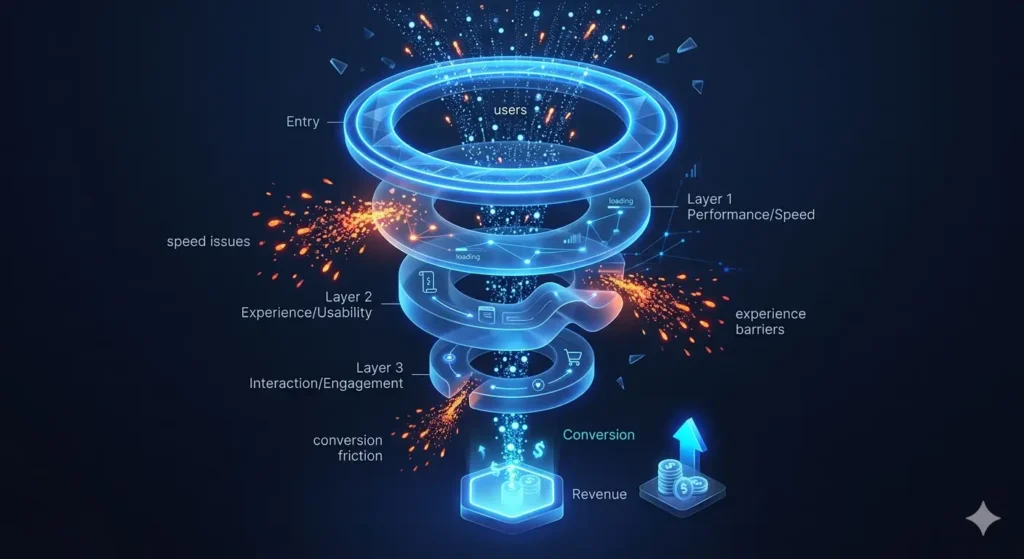
Most website performance issues are structural, not hosting-related.
Common problems include:
- Unused JavaScript loading sitewide
- Render-blocking CSS is delaying visible content
- Heavy third-party scripts (chat, tracking, ads)
- Poor caching configuration
- Uncompressed or oversized images
- No script delay logic
Each issue adds milliseconds.
Milliseconds reduce perceived competence.
Users subconsciously associate speed with professionalism. Slow websites feel unstable. Fast websites feel trustworthy.
This invisible tax quietly affects bounce rate, engagement, and conversion performance.
These issues are part of a deeper system problem
Why Website Speed Optimization Directly Impacts Revenue
Fast websites feel premium.
Slow websites feel risky.
Research consistently shows that even a one-second delay in loading time can reduce conversion rates significantly. When your website loads in 4–5 seconds instead of 2 seconds, visitors hesitate.
Hesitation reduces action.
Website speed optimization is not about vanity metrics like PageSpeed scores. It’s about protecting revenue and reducing friction in the user journey.
Performance influences:
- Conversion rate
- Ad ROI
- SEO rankings
- Brand perception
- Mobile engagement
Ignoring performance is not neutral. It is expensive.
Slow performance directly affects conversion and trust.
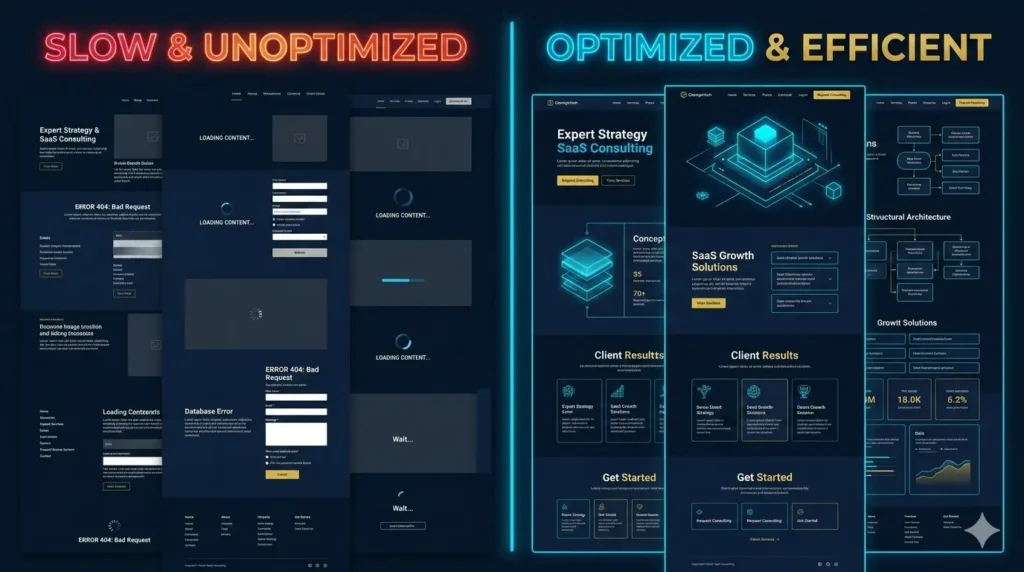
Most performance issues are not visible — until they start affecting your revenue.
7 Structural Issues Slowing Your Website
These are not random errors — they are structural gaps
1. Global Asset Loading
Plugins often load CSS and JS everywhere, even where not needed.
2. Poor Caching Strategy
Default caching is rarely optimized for dynamic content.
3. Third-Party Script Overload
Tracking tools and widgets accumulate silently.
4. Heavy Page Builder Markup
Bloated DOM structures increase render time.
5. No Image Compression Strategy
Large images without WebP or AVIF slow initial load.
6. Lack of Script Delay Configuration
Non-critical scripts trigger too early.
7. No Regular Website Performance Audit
Without review, decay compounds.
Website performance optimization requires structural clarity, not random plugin stacking.
How to Fix a Slow Website Properly
If you want to fix a slow website correctly, focus on architecture:
- Remove unused CSS and JavaScript
- Implement intelligent script delay
- Optimize the critical rendering path
- Configure multi-layer caching
- Compress and serve next-gen images
- Use a properly configured CDN
- Monitor performance consistently
A proper website performance audit identifies bottlenecks and prioritizes structural fixes.
Speed plugins alone rarely solve root problems.
Optimization is a systems decision.
fixing performance requires strategy, not just tools
When Should You Review Website Performance?
Ask yourself:
- Has your website grown significantly in the past year?
- Have multiple plugins been added recently?
- Is bounce rate increasing?
- Are paid ads running, but conversions stagnating?
- Has the loading speed fluctuated recently?
If yes, you likely need website performance optimization at a structural level.
You don’t necessarily need a redesign.
You need clarity.
Final Thought
Website performance optimization is not about chasing perfect scores.
It’s about maintaining digital reliability.
Performance doesn’t collapse overnight.
It drifts.
If you don’t review structure intentionally, your website gradually becomes slower, heavier, and less competitive.
Not with a crash.
With erosion.
And erosion is harder to notice — until revenue reflects it.
Not sure where your website performance stands?
→ Request a Website Performance Audit
→ See Optimization Case Studies
Most websites don’t fail because of traffic — they fail because they leak revenue