
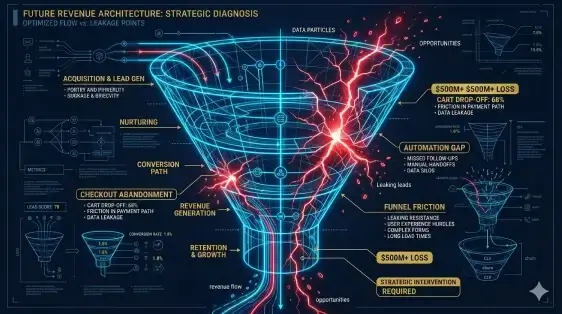
Most businesses don’t have a traffic problem.
They have a revenue architecture problem.
Revenue Is Structural
Most businesses don’t lose money in obvious ways.
Their checkout works.
Payments go through.
Traffic keeps coming.
Yet growth feels inconsistent.
The reason is structural inefficiency inside the revenue system.
Website revenue leaks rarely look dramatic. They appear as small friction points across pricing, checkout, messaging, and automation layers. Individually, they seem minor. Collectively, they reduce profitability.
Revenue erosion typically shows up through:
- High drop-off before payment
- Friction inside checkout flow
- Weak post-purchase engagement
- Missing lifecycle automation
- Unclear value communication
These are architectural gaps, not surface-level mistakes.
Websites should operate like systems — not brochures
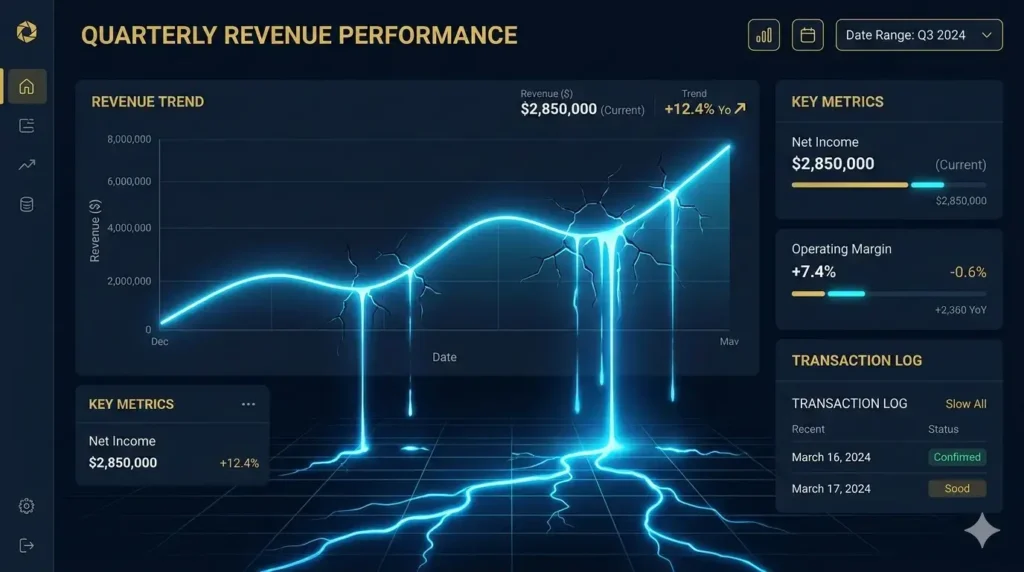
This is where most businesses get misled — growth looks real, but profit is leaking underneath.
Most websites don’t fail because of traffic.
They fail because revenue was never designed.
The Real Conversion Problem
This is not a technical issue.
It’s a revenue design failure.
Many teams focus on traffic before fixing internal performance.
But revenue instability often comes from unresolved website conversion issues.
When visitors hesitate, delay decisions, or fail to complete transactions, something inside the funnel is unclear.
Common structural causes include:
- Too many steps before payment
- Poor mobile flow
- No urgency reinforcement
- Weak trust positioning
- Lack of reassurance during checkout
This is where proper conversion rate optimization matters — not cosmetic tweaks, but friction removal.
If hesitation exists anywhere between interest and payment, revenue potential declines.
why your website isn’t converting even with traffic
Checkout Friction and Drop-Off
Every second of friction increases the probability of abandonment.
Checkout abandonment remains one of the biggest silent profit drains.
Users leave when:
- Extra costs appear unexpectedly
- Forms feel long or confusing
- Payment security is unclear
- Load time feels slow
- There is no visible support
Even a small hesitation can reduce completion rates significantly.
Reducing this friction requires structured analysis, not guesswork.
Many businesses attempt to reduce cart abandonment with a single reminder email. But without reviewing the entire checkout architecture, improvement remains limited.
slow website performance directly impacts conversion

The Automation Layer
Without automation, every customer becomes a one-time transaction.
Revenue does not end at payment.
It continues through retention and expansion.
When businesses ignore post-purchase structure, they miss opportunities to increase website revenue without additional traffic costs.
Missing elements often include:
- Upsell sequencing
- Follow-up onboarding
- Cross-sell triggers
- Referral mechanisms
- CRM-based segmentation
Without these systems, each customer represents a single transaction instead of a long-term relationship.
This leads to unnecessary ecommerce revenue loss over time.
Automation multiplies value per user. Without it, growth depends solely on acquiring new traffic, which is expensive and unstable.
missing automation systems reduce lifetime value
Funnel Structure and Flow Clarity
Most businesses never audit this flow — and that’s where revenue disappears silently.
Effective sales funnel optimization requires examining every transition point:
- First interaction
- Consideration stage
- Payment stage
- Post-purchase stage
- Retention stage
At each stage, ask:
- Is the next step obvious?
- Is pricing transparent?
- Is reassurance visible?
- Is friction minimized?
Most businesses improve isolated elements.
Few redesign structural flow.
When flow clarity is weak, website revenue leaks expand gradually, not through crashes, but through hesitation.
Over months, that hesitation compounds into measurable ecommerce revenue loss.
conversion rate optimization depends on structure
Identifying Structural Gaps
If revenue growth feels unstable despite consistent traffic, review the structure before marketing.
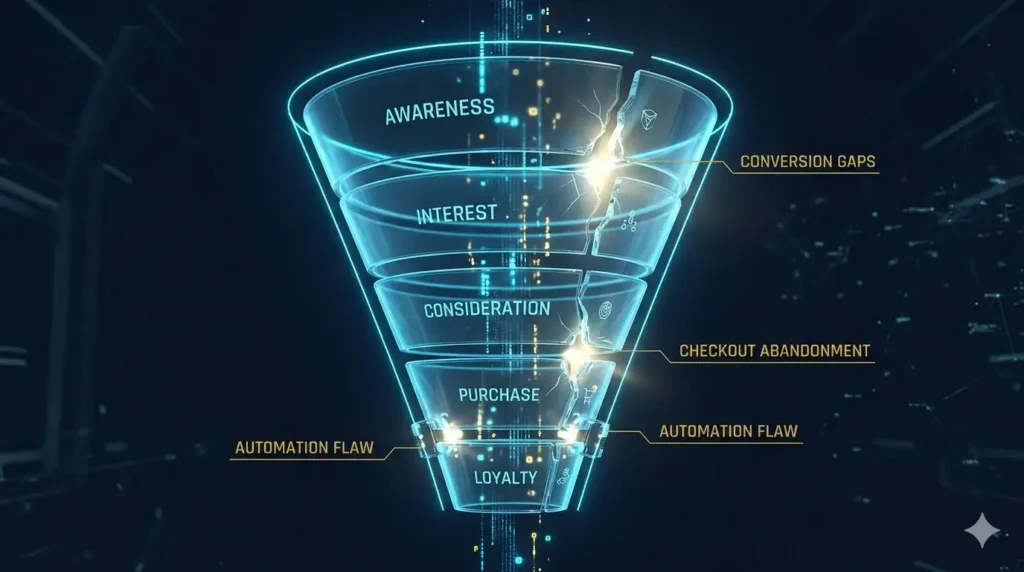
Look for:
- High drop-off before checkout
- Low repeat purchase rate
- No behavioral automation
- Poor mobile performance
- Lack of post-sale engagement
These patterns signal underlying system inefficiency.
Sales funnel optimization is not about adding more tools.
It is about removing friction and aligning transitions.
Final Thought
Revenue stability comes from architecture, not aesthetics.
When payment works, but profit feels inconsistent, the issue is rarely advertising alone.
It is often friction embedded inside the system.
Structural inefficiencies weaken performance slowly.
Without deliberate review, small gaps accumulate.
If growth feels harder than it should be, examine the internal structure before scaling traffic.
That is where sustainable improvement begins.
You’re Not Losing Traffic. You’re Losing Revenue.
And it’s happening inside your system — not outside it.