
Introduction
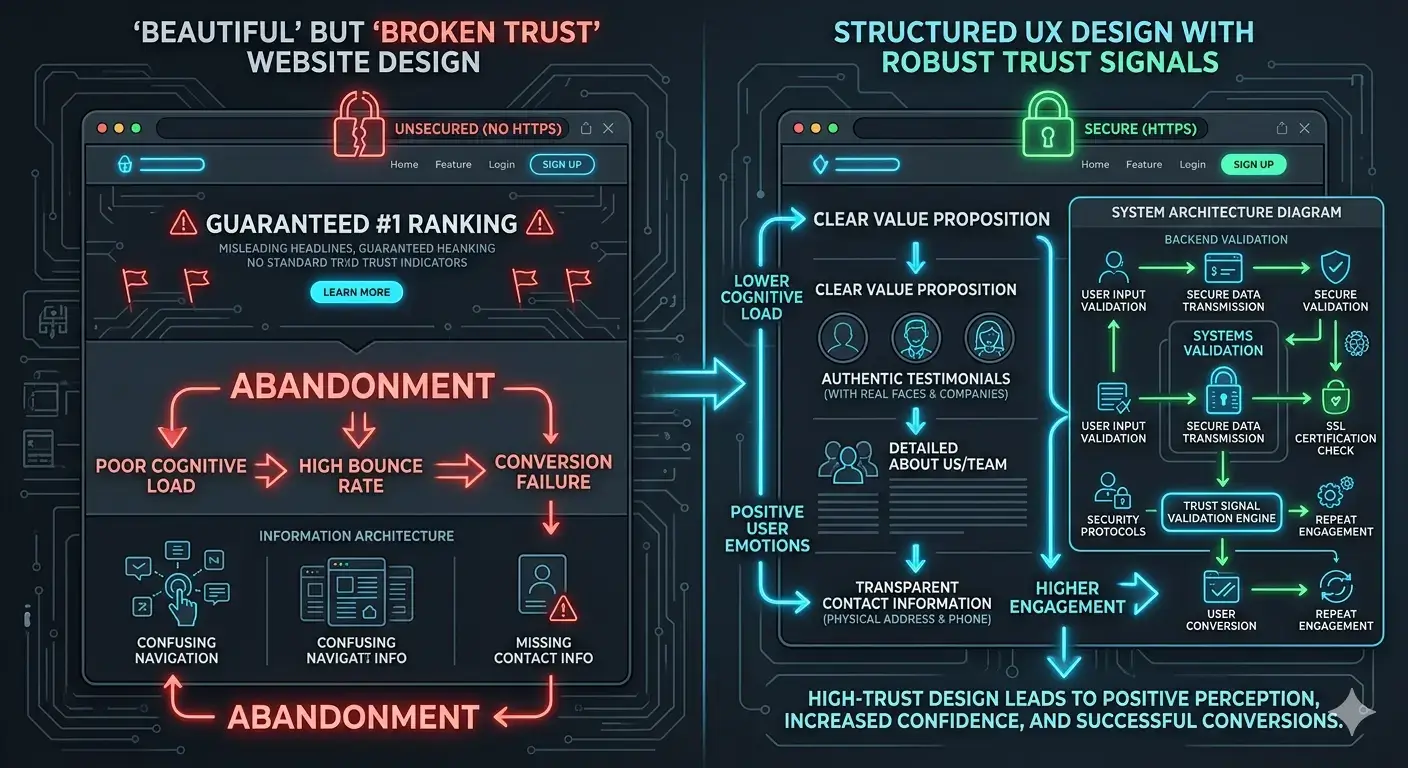
Most businesses believe trust is created through branding or visual design alone and cannot drive results.
Better colors, a modern layout, and attractive graphics are expected to increase credibility.
In reality, website trust signals are not visual decoration.
They are structural elements embedded into the user experience.
Users rarely buy simply because they understand a product.
They buy when they feel safe moving forward.
When trust is missing, hesitation appears.
When hesitation appears, conversions disappear.
Understanding how website trust signals function inside UX architecture is therefore critical for any business website.
Trust Is Built in Structural Layers
Trust is not a single feature.
It emerges from multiple structural layers working together.
Many websites fail not because of missing elements, but because there is no system connecting them. If your website operates like disconnected pages instead of a structured flow, trust cannot form. Learn how systems define performance in Website System Architecture: Why Websites Should Operate Like Systems — Not Brochures.
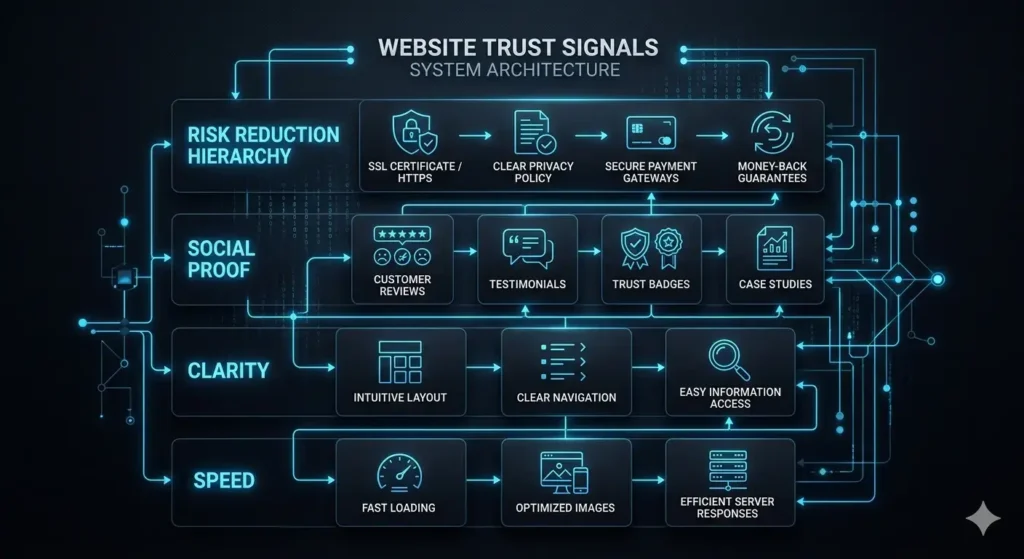
The most important layers include:
- Speed – slow websites trigger uncertainty and abandonment.
- Clarity – users must instantly understand what the site offers.
- Social proof – testimonials and reviews validate decisions.
- Risk minimization – guarantees, policies, and transparent terms reduce fear.
- Consistent hierarchy – predictable layouts reduce cognitive load.
When these layers operate together, trust becomes almost invisible.
Users simply feel comfortable progressing through the website.
Without these layers, even visually impressive websites struggle to convert.
Micro Website Trust Signals
While structural layers build the foundation, smaller details reinforce credibility.
These micro website trust signals often determine whether users continue or leave.

Examples include:
- visible privacy and refund policies
- clear pricing without hidden costs
- testimonials from real clients
- authentic imagery instead of stock photos
- recognizable payment systems
- reduced cognitive friction in forms
Each signal alone may appear minor.
Together, they create an environment where users feel confident making a decision.
Trust does not rely on persuasion.
It relies on removing uncertainty.
The Hidden Cost of Missing Trust
Many conversion problems originate from missing trust signals rather than marketing failures.
In many cases, these issues are not visible during design — they appear in performance and behavior metrics. See how performance issues silently impact trust in The Hidden Cost of Website Performance Issues.
A website may receive traffic but still lose potential customers because users hesitate at key moments.
Common symptoms include:
- visitors leaving pricing pages quickly
- form abandonment during checkout
- low engagement with CTAs
- high bounce rates on landing pages
In these situations, businesses often attempt to increase traffic or redesign visual elements.
However, the real issue is structural.
If website trust signals are weak or missing, additional traffic only increases the number of lost opportunities.
Improving trust architecture frequently produces faster results than increasing marketing budgets.

Trust Architecture in Modern UX
Modern websites must function as operational systems, not static brochures.
Trust architecture, therefore, becomes part of the broader UX strategy.
A strong trust system typically includes:
- transparent product or service explanations
- clear navigation and information hierarchy
- structured testimonials and case studies
- predictable checkout flows
- visible support channels and contact information
When these elements are integrated into the structure of the website, the user journey becomes stable and predictable.
This stability is what creates trust.
Design alone cannot achieve this.
Structure must support it.
If your website is generating traffic but failing to convert, the issue is rarely traffic itself. It is usually a structural gap in trust and user experience. See why this happens in Why Your Website Traffic Isn’t Turning Into Revenue.
Final Thought
Trust is rarely noticed when it exists.
Users simply continue moving forward.
But when it is missing, hesitation appears immediately.
Businesses that treat trust as a structural component of UX gain a significant advantage.
Their websites convert more efficiently because users feel safe making decisions.
The difference between a website that attracts attention and one that generates revenue is often invisible.
It is built into the architecture.
And that architecture is trust.
Your Website Doesn’t Need More Design — It Needs Trust Architecture
Most businesses try to fix trust with visuals.
But trust is built through structure, clarity, and system thinking.
If your website looks good but doesn’t convert —
there’s a structural problem behind it.