
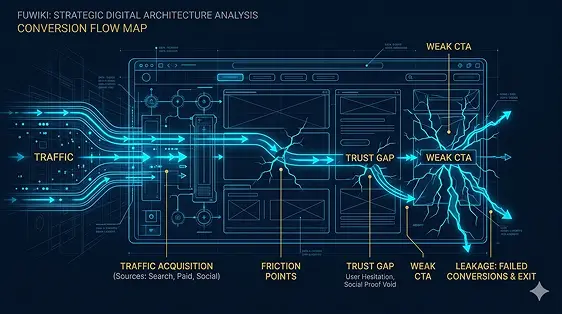
If you’re asking yourself why website is not converting even though traffic is increasing, you’re not alone.
Many founders celebrate traffic spikes.
Google Analytics looks healthy.
Ad campaigns bring clicks.
But revenue doesn’t move.
The problem is rarely traffic.
The real problem is structure.
Why a Website Not Converting Starts With Misalignment
Most websites are built visually — not strategically.
They look good.
But they don’t guide behavior.
Common conversion rate issues website problems include:
- No clear value proposition
- Weak message hierarchy
- Confusing navigation
- No defined user path

The Illusion of Traffic Growth
Traffic creates attention.
Conversion creates revenue.
A website not converting is usually suffering from hidden structural issues:
- Weak hierarchy
- Unclear value positioning
- Multiple competing CTAs
- Poor booking or checkout flow
You don’t have a traffic problem.
You have a conversion architecture problem.
Many websites already have hidden structural issues affecting performance.
You Have Traffic — But No Direction
Getting traffic is only the first step.
Conversion happens when users are guided.
Without direction:
- Users explore randomly
- Important actions are missed
- Decision-making slows down
This is the core of website traffic, but no sales problem.
Your site becomes a browsing space — not a conversion system.
Why Traffic Alone Doesn’t Guarantee Sales
Having high traffic is a great start, but a low website conversion rate means your hard-earned visitors are slipping through the cracks. This often happens when the user journey is disconnected or confusing.
Many business owners assume that increasing traffic automatically increases revenue.
In reality, traffic without structure often increases bounce rate.
According to multiple conversion rate optimization studies, the average website conversion rate across industries ranges between 2% and 4%, with structural conversion leaks.
That means:
Out of 100 visitors,
96–98 will leave without converting.
If your website conversion rate is below that benchmark, the issue is rarely traffic volume. It is usually:
- Poor user flow
- Friction in decision making
- Lack of trust reinforcement
- Weak call-to-action placement
This is why simply running ads or investing in SEO without structural optimization often leads to frustration.
Traffic scales attention.
Structure scales revenue.
7 Reasons Why Website Is Not Converting
1. Weak Value Proposition
Visitors cannot understand what you actually do in 5 seconds.
2. Friction in the Booking or Checkout Flow
Each extra step reduces conversion rate.
Every extra step reduces conversion.
Friction appears as:
- Too many inputs
- Slow loading pages
- Confusing navigation
Users don’t analyze.
They leave.
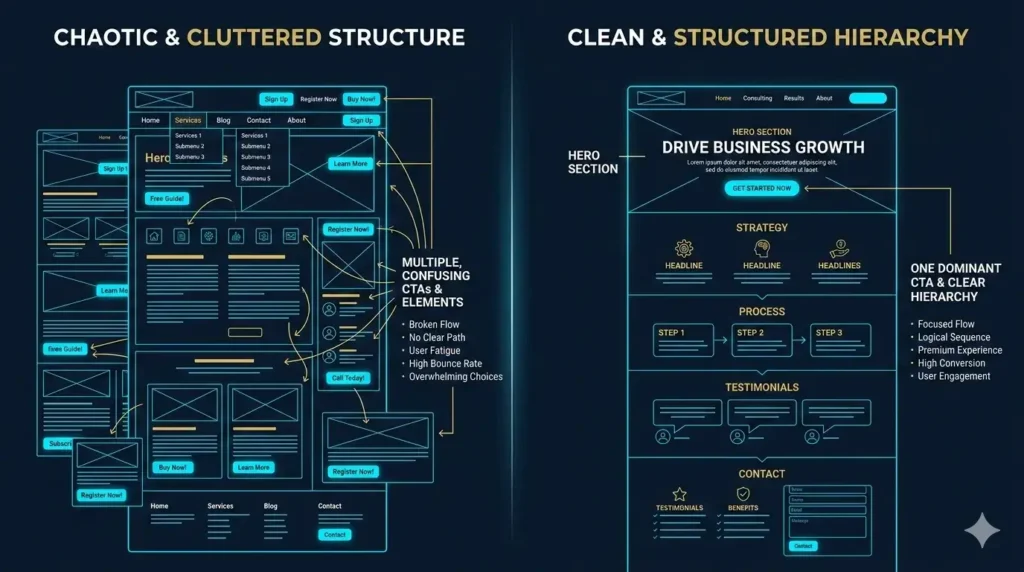
3. Cognitive Overload
Too many options = no decision.
4. Trust Gaps
No social proof.
No testimonials.
No case studies.
Users don’t convert instantly.
They evaluate.
They question:
- Is this business reliable?
- Can I trust this offer?
- What happens next?
Without strong trust signals:
- Testimonials
- Clear process
- Social proof
- Guarantees
Users hesitate.
And hesitation kills conversion.
This is one of the most common website conversion problems.
5. No Clear Primary CTA
Multiple buttons compete for attention.
6. Mobile Experience Is Broken
More than 60% of traffic is mobile.
If mobile UX is weak, conversion rate drops instantly.
7. No Conversion Optimization Strategy
You are designing.
Not optimizing.
The Psychology Behind Website Conversion Problems
If your website is not converting, the problem is rarely visual.
It is psychological.
Users subconsciously evaluate three things within seconds:
- Is this relevant?
- Is this safe?
- Is this worth my time?
If any of these questions create hesitation, conversion drops.
For example:
- Unclear pricing creates risk.
- Long forms create friction.
- Multiple CTAs create confusion.
- Lack of testimonials reduces perceived credibility.
Conversion rate optimization is not about design trends.
It is about reducing perceived risk.
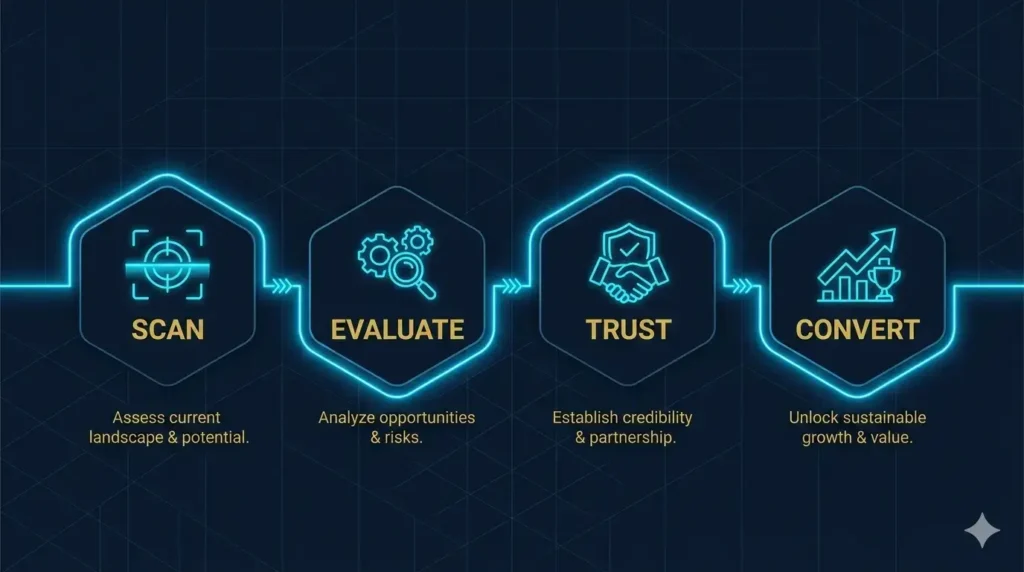
Conversion Is Flow, Not Design
Conversion doesn’t happen on one page.
It happens across a flow:
Landing → Understanding → Trust → Decision
If one step breaks, the whole system fails.
Users don’t “browse.”
They scan → evaluate risk → decide.
If your website conversion rate is low, it’s because:
- The risk feels high
- The decision feels unclear
- The next step feels confusing
Websites should operate like systems
Improving website conversion rate requires structural clarity, not visual redesign.
conversion optimization strategy
How to Increase Website Conversion Rate Structurally
To effectively improve website conversion rate metrics, you need to stop guessing and start optimizing the structural elements that build trust with your audience.
Instead of redesigning everything, fix:
- Clear hierarchy
- Reduced decision fatigue
- Visible trust layers
- Single dominant CTA
- Shorter checkout flow
These small structural changes often increase conversion rate dramatically.
A Simple Conversion Optimization Framework
If you want to increase your website conversion rate, start with these three structural layers:
1. Clarity Layer
- One clear headline
- One dominant CTA
- Clear benefit-driven copy
2. Trust Layer
- Testimonials
- Case studies
- Real metrics
- Clear guarantees
3. Friction Layer
- Reduce form fields
- Shorten checkout steps
- Improve mobile UX
- Remove unnecessary navigation distractions
Small structural changes often increase website conversion rate more effectively than a full redesign.
While every business is unique, these conversion rate optimization tips focus on the universal pillars of speed, clarity, and psychological triggers that drive action.
Final Thought
If your website gets traffic but no sales,
It’s not a marketing failure.
It’s a structural misalignment.
Before buying more ads,
fix the conversion system.
Want to know exactly why your website is not converting?
Fix What’s Blocking Your Conversions
Your traffic is not the problem.
Your system is.
→ Request a Conversion Audit
→ See Conversion Case Studies
If your website traffic isn’t turning into revenue, it’s usually not a traffic issue — it’s a system issue.
Understanding how traffic connects to revenue is critical.
Why your website traffic isn’t turning into revenue