
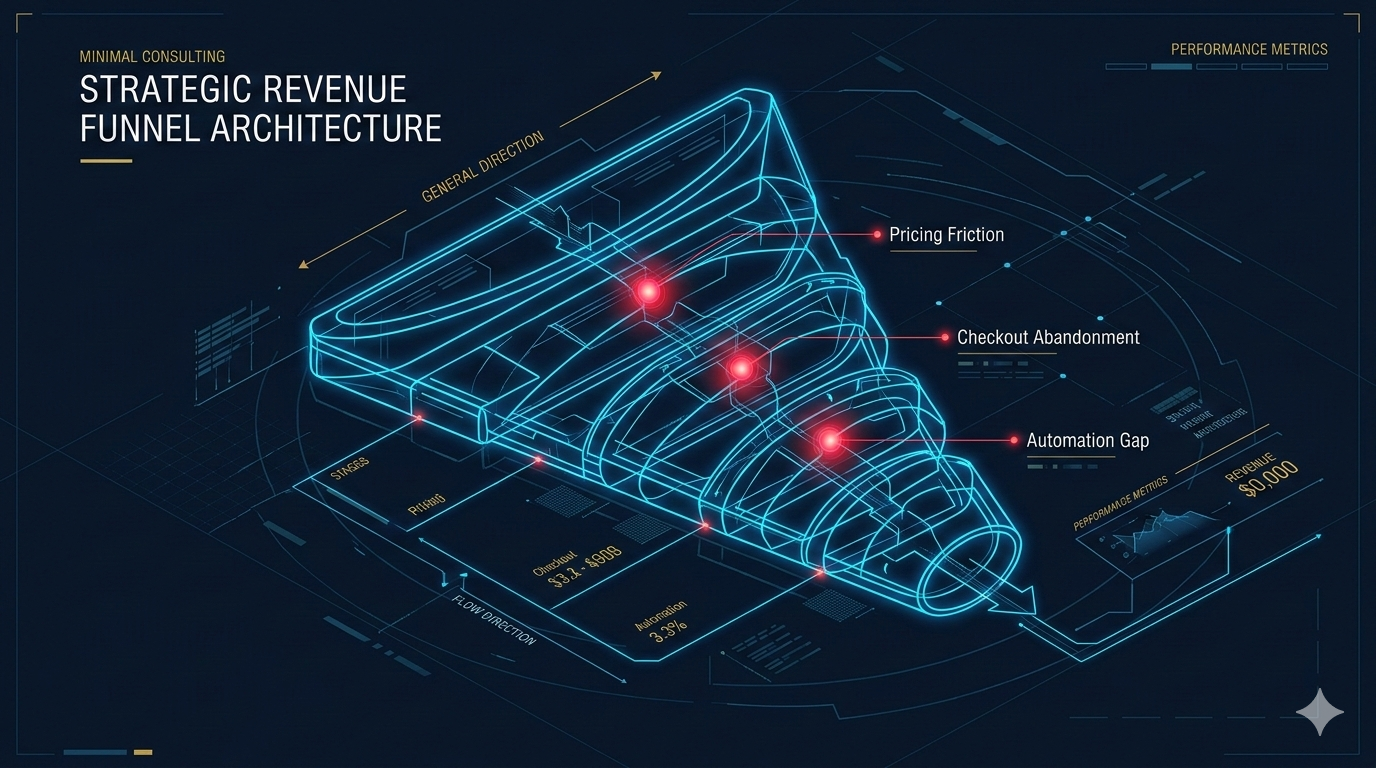
Conversion rate optimization is often approached the wrong way.
Many businesses assume slow e-commerce revenue growth means they need more traffic. So they increase ad budgets, expand campaigns, and push acquisition harder.
hidden conversion leaks inside your website
Yet revenue instability continues.
The real issue is rarely traffic volume.
It is structural friction inside the system.
Payments work.
Visitors arrive.
Ads perform.
But hesitation appears in small, almost invisible moments.
Over time, those moments compound into measurable revenue loss.
True conversion rate optimization focuses on removing friction at a structural level — not just improving surface elements.
Revenue Leaks Are Architectural
Website revenue leaks rarely come from dramatic failures.
They come from:
- Unclear offer positioning
- Weak value reinforcement
- Pricing hesitation
- Misaligned messaging
- Missing automation layers
Individually, these feel minor. Collectively, they reduce profitability.
Many teams run small A/B tests or redesign sections of a page. While helpful, those actions often miss the underlying system.
Sustainable ecommerce revenue growth depends on how clearly the entire journey is engineered.
This is where structural thinking matters more than cosmetic tweaks.
Checkout Abandonment and Hidden Friction
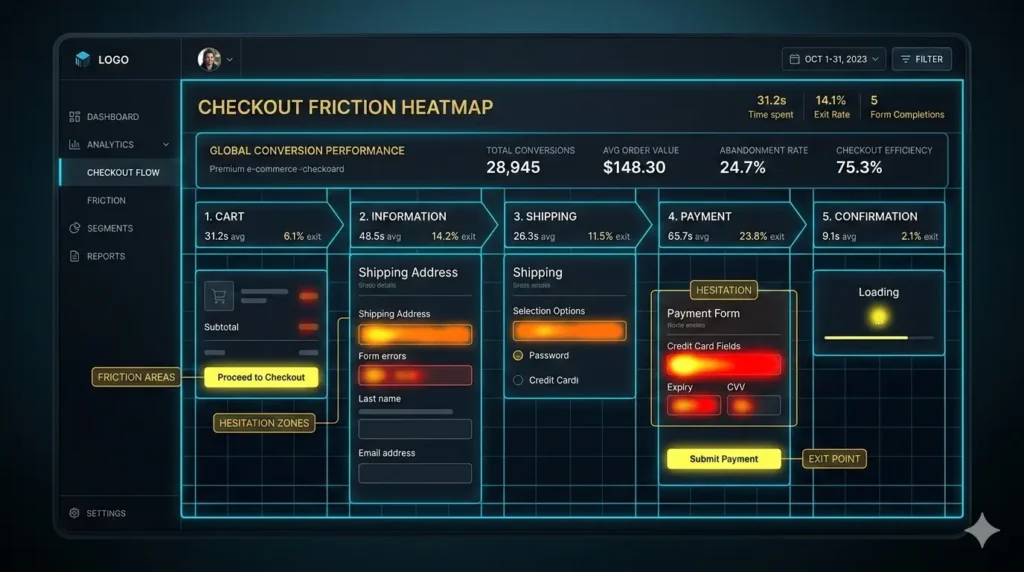
Checkout abandonment remains one of the biggest silent profit drains.
Customers hesitate when:
- Unexpected costs appear
- Forms are too long
- Payment methods feel limited
- Trust signals are weak
- Mobile performance is inconsistent
Each hesitation lowers completion probability.
To reduce cart abandonment, the entire checkout experience must feel predictable and safe.
This is not about sending reminder emails after the drop-off.
It is about preventing the drop-off in the first place.
That requires examining flow clarity, reassurance, and decision simplicity.
Most users don’t leave because they’re not interested.
They leave because something feels off.
Sales Funnel Optimization as Flow Alignment
Sales funnel optimization is often misunderstood as “adding more pages.”
In reality, it is about aligning transitions.
At every stage of the journey:
- Is the next step obvious?
- Is the value reinforced?
- Is risk minimized?
- Is trust visible?
- Is friction reduced?
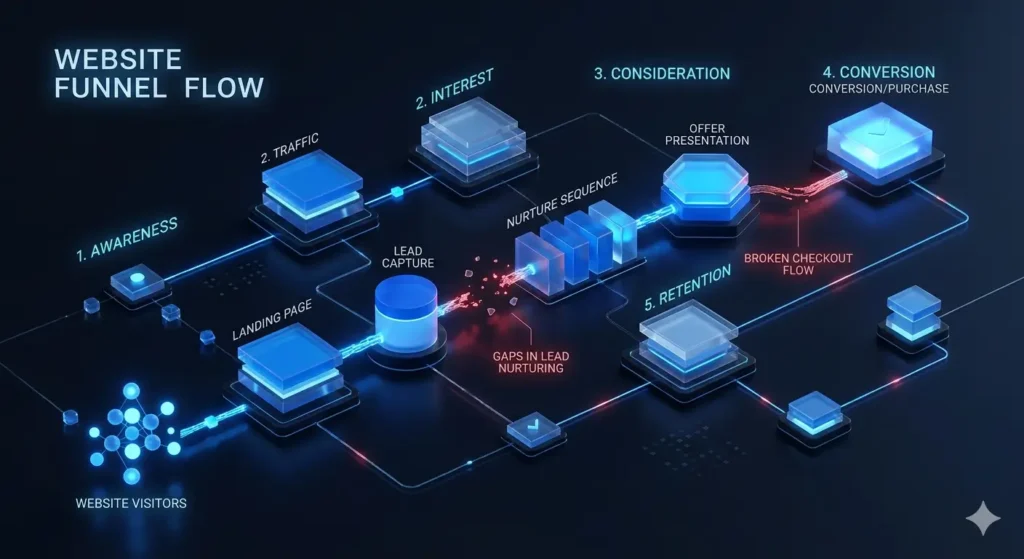
Most websites optimize pages individually but ignore the connection between stages.
When transitions are unclear, visitors pause.
When they pause, doubt increases.
When doubt increases, revenue declines.
Website revenue leaks expand gradually — not through crashes, but through hesitation.
The Automation Multiplier
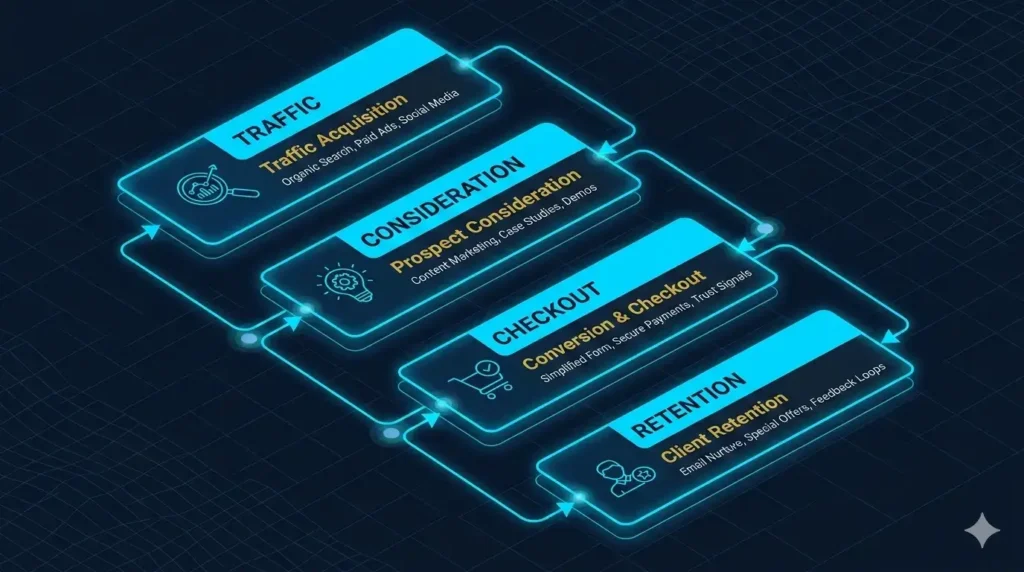
Structural improvement does not stop at payment.
After purchase, systems should activate:
- Upsell pathways
- Onboarding sequences
- Behavioral email flows
- Cross-sell opportunities
- Retention mechanisms
Without automation, each sale remains isolated.
core systems every website needs
With automation, each transaction becomes part of a long-term revenue structure.
E-commerce revenue growth becomes more stable when retention and expansion are integrated into the system.
This is a major dimension of modern conversion rate optimization.
Identifying Structural Gaps
If performance feels inconsistent despite stable traffic, review:
- Drop-off before checkout
- Low mobile engagement
- Weak reassurance signals
- No post-purchase engagement
- Lack of segmentation
These patterns usually signal architectural inefficiency.
Structural friction does not always look dramatic in analytics dashboards.
It shows up in small behavioral shifts that compound over months.
Before scaling traffic, refine the internal system.
Your website doesn’t need more traffic.
It needs a system that converts.
Final Thought
Conversion rate optimization is not a shortcut tactic.
It is a structural discipline.
When growth feels harder than it should be, the issue is rarely advertising alone.
It is usually hidden inside the architecture of the journey.
Align offers clarity.
Reduce friction.
Strengthen flow.
Build retention systems.
Revenue stability follows structure.
That is how sustainable e-commerce revenue growth is built.
Not Sure Where Your Revenue Leaks Are?
Most leaks are invisible.
They live inside your funnel, not your design.
Start Your Project→
Explore System Approach→