
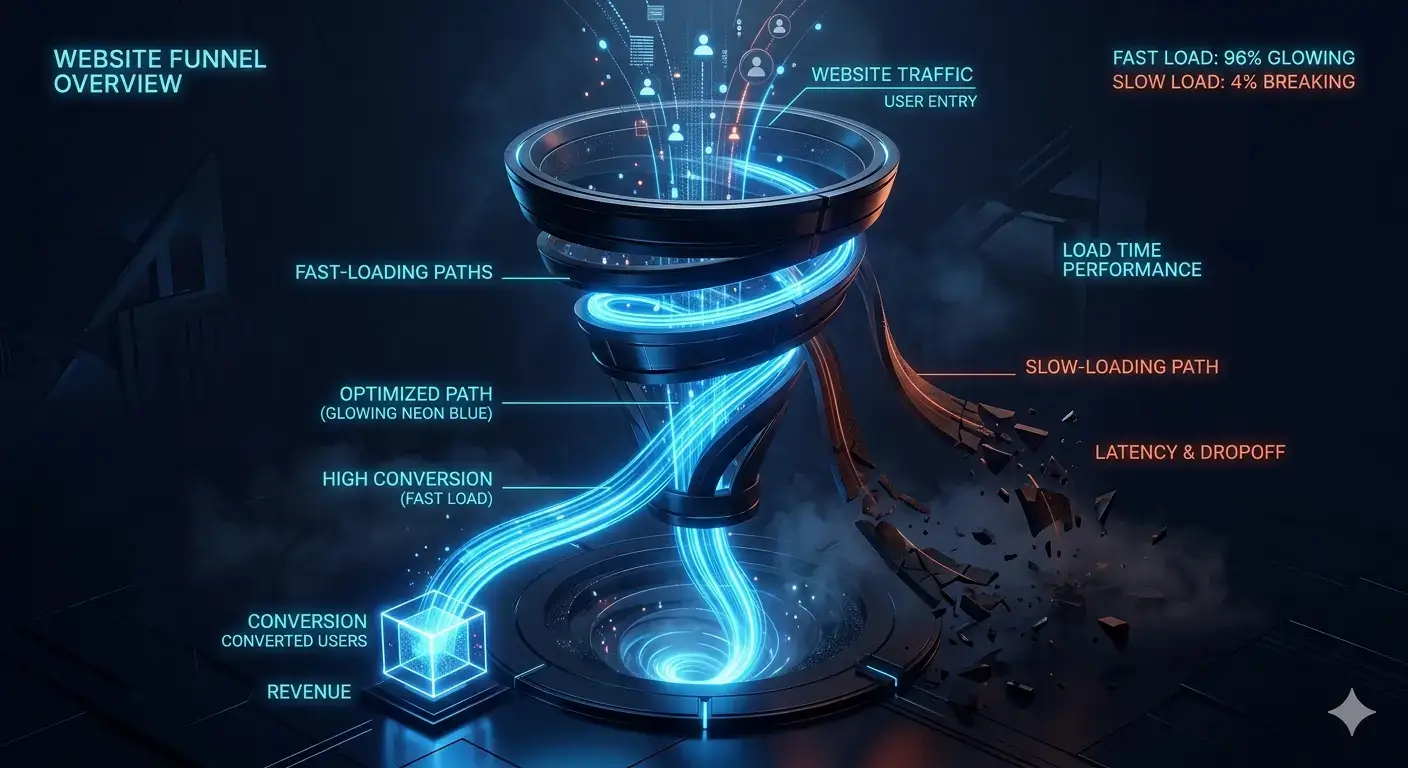
Revenue Loss Starts Before Conversion
Most businesses think revenue loss happens at the checkout.
It doesn’t.
It starts much earlier — the moment a user lands on your website and experiences delay.
This is the real website speed revenue impact most companies ignore.
A slow-loading page doesn’t just test patience. It creates doubt.
Users begin to question:
- Is this business reliable?
- Will the process be smooth?
- Is it worth continuing?
That hesitation reduces engagement before your offer is even understood.
This is why website speed and conversions are directly connected.
The Hidden Psychology of Speed
Speed is not just technical performance.
It’s perception.
When a website loads instantly, it feels:
- professional
- trustworthy
- structured
When it loads slowly, it feels:
- broken
- outdated
- unreliable
This psychological shift is where the slow website impact on revenue begins.
Users don’t consciously analyze speed.
They react to it.
And most of the time, that reaction is leaving.
slow website impact on revenue
Speed Directly Affects Conversion Flow
Conversion is a sequence.

Not a single action.
From landing → scrolling → interaction → decision → action.
At every step, speed plays a role.
A delay in:
- page load
- image rendering
- form response
- checkout processing
creates friction.
And friction breaks flow.
This is where page speed conversion rate starts dropping.
Even a 1–2 second delay can:
- reduce clicks
- decrease form submissions
- increase bounce rate
Performance Issues Are Revenue Leaks
Most websites don’t fail loudly.
They leak revenue quietly.
Performance issues often include:
- unoptimized images
- heavy scripts
- poor hosting
- unnecessary plugins
- lack of caching
Individually, they seem small.
Combined, they create serious website performance issues that reduce revenue.
This is the technical side of website performance optimization — but its impact is financial.

Speed Impacts Trust More Than Design
A beautiful website that loads slowly loses trust faster than an average website that loads instantly.
Why?
Because users interpret speed as competence.
Fast = organized
Slow = unreliable
This is where website loading speed UX becomes critical.
It’s not just about visuals.
It’s about how fast users can move through your system.
Checkout Speed Determines Revenue Completion
The biggest drop-offs happen at the most critical point — checkout.

Users are already ready to buy.
But then:
- checkout loads slowly
- payment takes time
- form lags
That’s where revenue disappears.
This is the most direct website speed revenue impact point.
Because now, the loss is not potential.
It’s real.
Speed Is Not a Feature. It’s Infrastructure.
Many businesses treat speed as an optimization task.
It’s not.
It’s a foundational system layer.
If your website is built without performance in mind:
- scaling becomes harder
- integrations slow everything down
- user experience degrades over time
This is why improve website speed for sales is not a one-time fix.
It’s a structural decision.
Final Thought
Traffic doesn’t guarantee revenue.
Speed determines whether that traffic converts.
If your website is slow, every visitor costs more — and returns less.
That’s the real website speed revenue impact.
Diagnose the Real Impact of Your Website Speed
A slow website rarely feels like the main problem.
But it quietly affects every part of your system — from trust to conversions to revenue.
If your site gets traffic but does not generate results, speed may be the missing layer.
Request a Website Performance Audit
Explore Conversion-Focused Systems