

Website Structure Impact: Why the Hidden Cost Is Bigger Than Design
Website structure impact is not only about how a page looks or how fast it loads. A website can feel modern, score well in a test, and still lose serious business opportunities if the structure behind the user journey is weak. The real cost appears when visitors do not understand the next step, leads arrive without context, follow-ups become manual, and sales teams waste time fixing confusion that the website should have prevented.
Many businesses first notice the problem as a performance issue. They compress images, remove plugins, improve hosting, and chase a better speed score. Those fixes can help, but they do not repair poor website structure. If the visitor path is unclear, the offer is not positioned properly, or the form does not connect to a useful process, speed alone will not create a conversion-focused website.
1. Poor Structure Makes Good Traffic Less Valuable
Traffic is only useful when the website can guide attention. A visitor should quickly understand who the service is for, what problem it solves, why the company is credible, and what action to take next. When that path is scattered across disconnected sections, the user has to build the logic alone.
This is where website structure impact becomes expensive. Paid ads, SEO traffic, social media visitors, and referrals can all land on the site, but the page may not convert because the journey is not structured around decision-making. The business pays to attract attention, then loses it through unclear movement.
2. Conversion Flow Breaks Before the Form
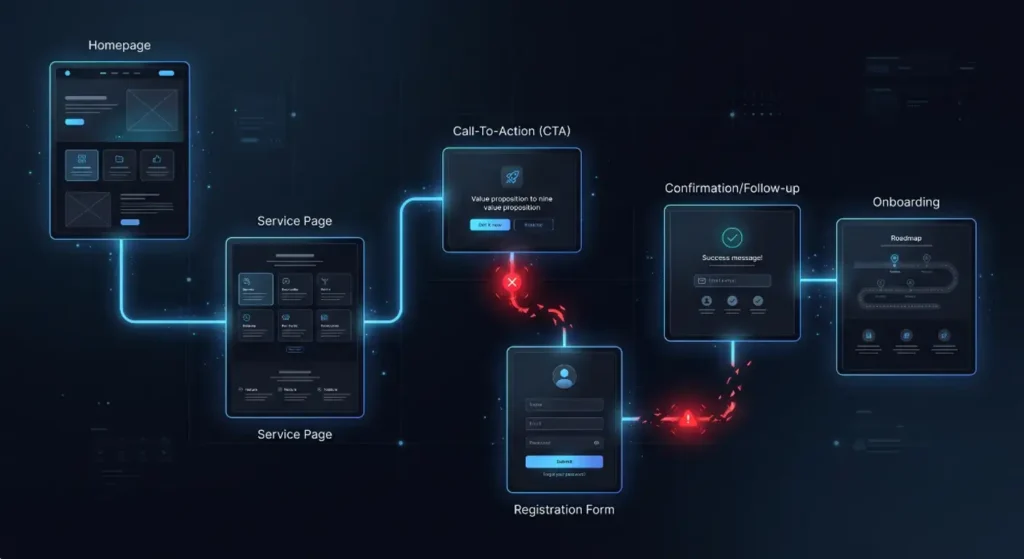
A weak conversion flow usually starts long before the contact form. It begins when the page introduces too many messages at once, hides the strongest offer, or sends users into pages that do not support the same goal. The result is hesitation.
A good structure does not push users aggressively. It organizes the decision. It answers doubts in the right order, shows proof before asking for commitment, and makes the next step feel logical. Without that, even a beautiful page becomes passive. The visitor may like the brand, but still leave without acting.
3. Customer Handling Becomes Manual and Slow
The hidden cost of customer handling appears after the lead is submitted. If the form only sends a basic email, the team may need to ask the same questions again. If the request is not categorized, the wrong person may respond. If the source is not tracked, the business cannot understand which channel is producing serious opportunities.
This is not just an admin issue. It affects response speed, trust, and sales quality. A structured website should collect the right details, route the inquiry properly, and reduce friction after the user takes action.
4. Website Structure Impact on Automation and CRM
One of the biggest signs of weak structure is when the website and sales process are separated. A form submission should not be the end of the system. It should trigger the next step: notification, tagging, lead source tracking, follow-up, or CRM integration.
Without lead flow automation, every inquiry depends on manual discipline. That may work when volume is low, but it becomes unreliable as campaigns grow. A stronger website automation system helps the business respond faster and keep data organized. This is where structure turns a website from a brochure into a working business tool.

5. Speed Fixes Cannot Repair Decision Gaps
Website performance optimization matters, but performance is not only technical. A fast page with weak hierarchy still creates confusion. A lightweight site with unclear CTAs still loses leads. A perfect score does not guarantee that the visitor knows what to do next.
This is why many redesigns fail. They improve visuals and speed, but keep the same structural gaps. The business gets a cleaner interface, while the deeper sales problem stays untouched.
6. Poor Structure Reduces Trust
Trust is not built by testimonials alone. It is built through clarity, consistency, proof, and smooth movement. If the navigation feels random, service pages repeat the same claims, or important details are hard to find, users begin to doubt the business.
A strong structure makes the company feel organized. It shows that the business understands the customer’s problem and has a process for solving it. That confidence is often what moves a visitor from interest to action.
7. The Real Cost Is Lost Sales Efficiency
The biggest cost of poor website structure is not one lost lead. It is the repeated loss of sales efficiency. Marketing brings people in, the website fails to qualify them properly, the team follows up manually, and management cannot clearly see where the process breaks.
To fix this, businesses need more than design polish. They need a website built around user decisions, lead quality, automation, and sales movement. When the structure supports the whole journey, the site becomes easier to use, easier to manage, and more valuable as a growth system.

Stop Fixing Pages. Start Fixing the System.
If your website looks good but still creates weak leads, slow follow-up, or unclear user movement, the problem may be structural. Mono Digital can review the journey, identify conversion gaps, and help you turn the site into a more organized business system.