

Small Decisions, Big Consequences
Most websites don’t fail because of one major issue.
They fail because of dozens of small ones.
These are the hidden ux mistakes website owners ignore every day.
Things like:
- unclear buttons
- inconsistent spacing
- confusing layouts
- weak visual hierarchy
Individually, they seem minor.
Together, they break the experience.
And when experience breaks, conversion follows.
Micro UX Is Where Conversion Is Won or Lost
Conversion doesn’t depend only on big elements like pricing or offers.

It depends on micro decisions:
- where a button is placed
- how fast feedback appears
- how readable content feels
- how intuitive navigation is
This is where micro ux decisions matter most.
Users don’t consciously analyze UX.
They feel it.
And if something feels off—even slightly—they hesitate.
That hesitation is where conversion drops.
Friction Is Invisible But Powerful
The biggest UX problem is not obvious errors.
It’s friction.
Friction shows up as:
- extra clicks
- unclear steps
- delayed responses
- confusing forms
These create subtle resistance.
Users don’t complain.
They just leave.
This is the real ux impact on conversion.

Confusion Destroys Trust Instantly
Users don’t give websites time to explain themselves.
If something is unclear:
- what to do
- where to click
- what happens next
trust drops immediately.
This is why many website ux mistakes are actually trust problems.
Confusion signals:
- lack of structure
- lack of professionalism
- lack of reliability
UX Is Not Design. It’s Flow
Many businesses confuse UX with design.
But UX is not how it looks.
It’s how it works.
A visually beautiful site can still fail if:
- navigation is unclear
- hierarchy is weak
- actions are not obvious
This is where user experience conversion rate starts failing.
Because users don’t convert based on visuals.
They convert based on clarity and ease.
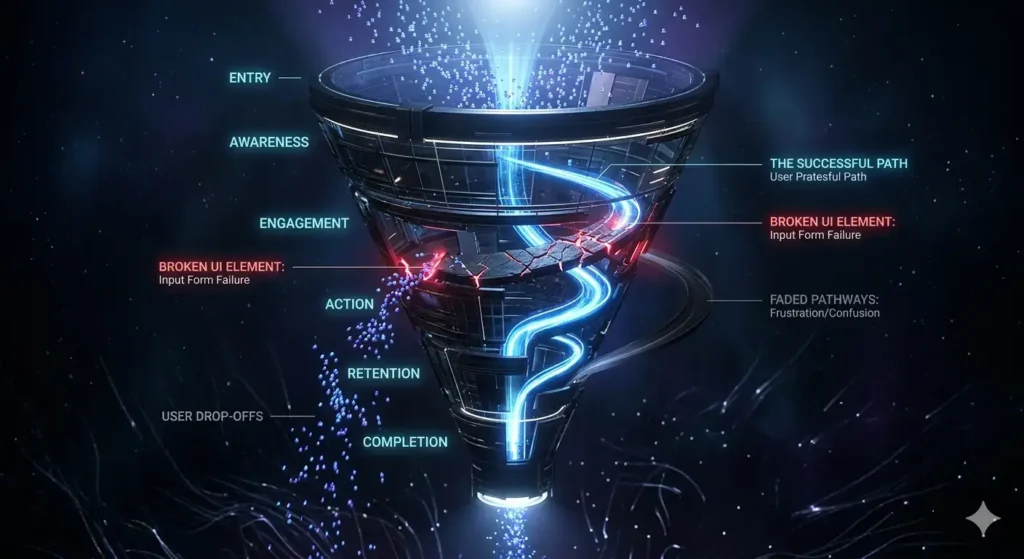
Bad UX Creates Drop-Off Points
Every website has drop-off points.
But most are caused by small UX issues:
- form too long
- CTA not visible
- unclear next step
- mobile layout problems
These are classic bad ux examples that website owners overlook.
And each one removes potential conversions.
Not because users are not interested.
But because the path is broken.
UX Problems Scale With Traffic
More traffic does not fix UX problems.
It amplifies them.
If your website has usability issues:
- more visitors = more lost opportunities
- more clicks = more friction
- more sessions = more drop-offs
This is why website usability issues directly affect revenue.
Because every inefficiency multiplies.
UX Optimization Is a System Decision
Most businesses try to fix UX with small tweaks.
But UX is not a surface-level issue.
It’s a system.
Good UX requires:
- structured layout
- clear flows
- fast response
- logical interactions
This is where ux optimization tips fail when applied randomly.
Because without structure, improvements don’t scale.
Final Thought
Users don’t leave because your website is bad.
They leave because it feels hard.
That’s the real impact of ux mistakes website owners ignore.
Fixing UX is not about redesign.
It’s about removing friction from the system.
Fix the UX Gaps That Quietly Kill Conversion
Most UX problems are not visible at first glance.
But they affect every interaction, every click, and every decision.
If your website gets traffic but doesn’t convert, UX is often the hidden layer breaking performance.
👉 Request a UX Conversion Audit
👉 See How We Build Conversion Systems