

A pagespeed optimization guide should not start with a score. It should start with one question: can your website help a real visitor move faster from interest to action? PageSpeed Insights is useful, but the number alone does not explain whether your lead form works, whether your offer is clear, or whether follow-up protects revenue.
Many service businesses chase a 90+ score while ignoring where customers get lost. A site can load quickly and still feel confusing. It can pass technical checks and still create website conversion problems because the journey is not structured. Real performance is about clarity, response speed, decision flow, and the system behind the page.
Why PageSpeed Scores Are Only One Layer
PageSpeed tools measure loading speed, interaction delay, layout stability, and resource weight. These checks matter because slow pages increase friction and damage trust. But a score is a diagnostic signal, not a business result.
Strong website performance optimization is not only about reducing load time; it is about improving how quickly users understand the offer, trust the business, and move toward action.
The bigger mistake is treating performance as a developer task only. Real website performance includes what happens before, during, and after the click. If a visitor lands on a fast page but sees weak messaging, unclear proof, too many steps, or a broken form, the business still loses the lead. That is why this pagespeed optimization guide connects speed with structure, UX, automation, and sales handling.
For technical validation, use Google PageSpeed Insights as an external benchmark, but judge success by how the website supports the customer journey.
Speed vs Real Performance
Speed answers: “How fast does the page load?”
Real performance answers: “How fast can the visitor understand, trust, act, and get handled by the business?”
That difference is where revenue is usually lost. A website can have acceptable Core Web Vitals but still fail because the hero section does not explain the offer, the CTA is vague, the form is too long, or the lead notification reaches the team too late.
This is why a strong website structure strategy matters. Performance is a system layer. Your pages, CTAs, forms, email alerts, CRM logic, and follow-up process must work together.
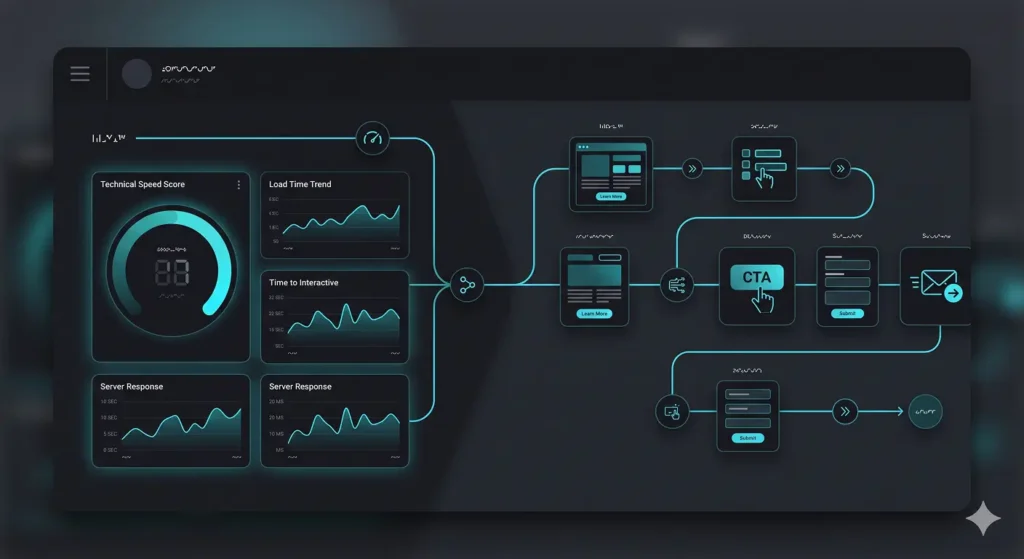
7 Real Performance Fixes That Matter More Than Chasing Scores
Traditional website speed optimization is still important, but the strongest results come when speed improvements are connected to UX, forms, automation, and conversion flow.
1. Make the Hero Section Instantly Clear
The first screen must answer who you help, what you fix, and what the visitor should do next. A fast page with a vague headline still creates hesitation.
2. Reduce Visual and Decision Noise
Heavy animations, oversized images, and too many competing sections can slow both the browser and the buyer. Clean hierarchy improves loading, reading, and action. This is where visual hierarchy website principles become part of performance.
3. Fix Forms Before Running More Ads
A broken or confusing form destroys real performance faster than a low score. Every contact form should be short, tested, mobile-friendly, and connected to the right email or CRM destination.
4. Automate Lead Capture and Notifications
Automation improves real performance because it reduces delay after the user takes action. When a form submission instantly triggers notifications, client confirmation, lead tagging, and follow-up tasks, the website becomes a sales machine instead of a static page.
This improves sales handling efficiency because the team receives cleaner lead data, faster alerts, and a clearer next step for every inquiry.
5. Connect Content to the Next Step
Good content should not simply educate. It should guide. If a visitor reads about a problem, the page should move them toward an audit, consultation, case study, or relevant solution. This improves lead conversion strategy without making the page feel aggressive.
6. Improve Mobile Interaction Quality
Many businesses check desktop screenshots but lose customers on mobile. Buttons must be easy to tap, forms must feel light, and sections must load in a logical order.
7. Measure Conversion Flow, Not Only Load Time
The strongest pages are measured by behavior: scroll depth, form starts, form completions, CTA clicks, and response time. A pagespeed optimization guide becomes valuable when it connects technical improvements to actual sales efficiency.
Where Automation Improves Website Performance

A website automation system does not make a website faster in the same way image compression does, but it makes the business faster after every inquiry. It makes the business faster. When lead routing, email confirmation, CRM updates, and sales reminders happen automatically, every inquiry becomes easier to handle.
The Better Way to Think About Optimization
The goal is not to ignore PageSpeed. The goal is to place it inside a bigger performance system: technical speed, customer journey, trust signals, CTA clarity, forms, automation, and follow-up.
That is the difference between score optimization and revenue optimization. A premium website should feel fast, clear, trustworthy, and easy to act on. When these layers work together, the site does more than load. It performs.

Is Your Website Fast Enough to Perform — Not Just Load?
A PageSpeed score can show technical issues, but it cannot show missed leads, weak CTAs, broken forms, unclear messaging, or slow sales handling. If your website gets traffic but does not create enough inquiries, the problem may be deeper than speed.