

Before You Redesign Your Website — Read This
Most businesses approach redesign with the wrong assumption:
“If it looks better, it will perform better.”
This is where your website redesign strategy starts to fail.
Because redesigning visuals without fixing structure doesn’t improve conversions. It simply repackages the same problems.
A redesign should not be a design project.
It should be a system upgrade.
A Website Redesign Strategy Should Start With Diagnosis
Before changing anything, you need to understand what is actually broken.
Most websites don’t fail because of outdated design. They fail because of deeper website conversion problems that were never properly diagnosed.
They fail because of hidden structural gaps:
- No clear conversion flow
- Weak content hierarchy
- Missing trust signals
- Disconnected pages
- Poor lead handling
This is where website structure strategy becomes important: before redesigning the interface, you need to understand how pages, content, CTAs, trust signals, and lead paths work together.
This is why a proper website redesign content strategy begins with analysis, not design.
If you skip this step, your redesign becomes expensive decoration.
Design Doesn’t Fix Conversion Problems
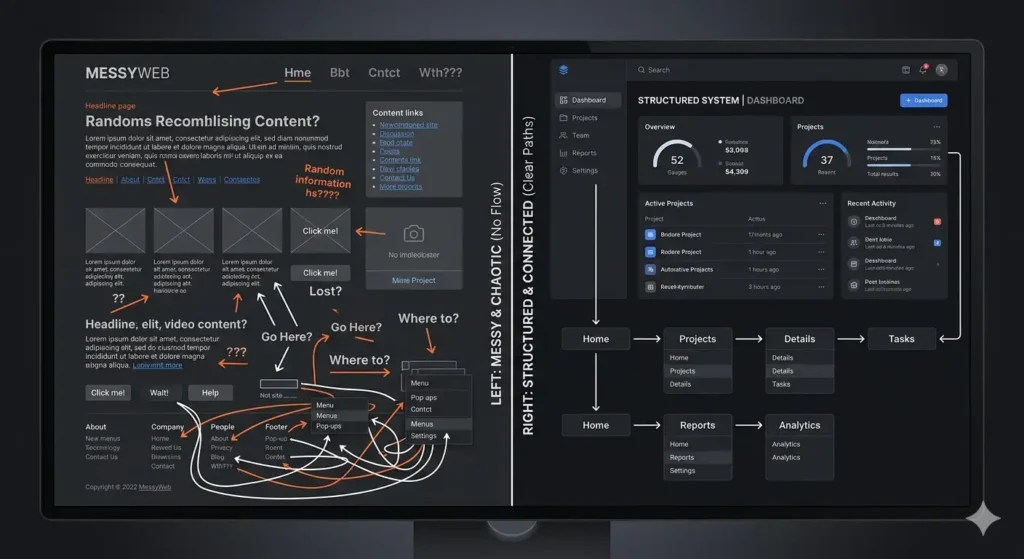
A common mistake in any website revamp strategy is assuming design equals performance.
In reality, design is only the surface layer.
If your website has:
- unclear messaging
- friction in user flow
- broken trust
- weak CTA logic
Then even the best design won’t convert.
This is exactly why many businesses experience what feels like invisible failure.
Your traffic doesn’t increase.
Your leads don’t improve.
Your results stay the same.
Because the problem was never visual.
Structure Is the Core of a Conversion-Focused Website
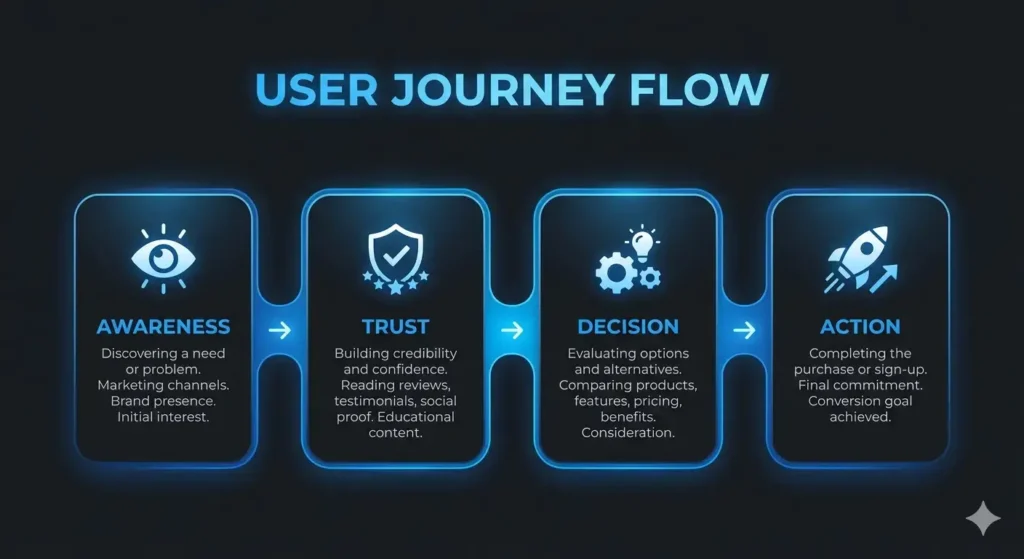
This is the foundation of strong website system architecture — every page should have a role, every section should support a decision, and every CTA should move the visitor forward.
A strong website redesign strategy focuses on structure first.
That means:
- defining user journeys
- mapping decision paths
- organizing content flow
- aligning pages with intent
Instead of thinking in pages, you need to think in systems.
A conversion-focused website is built like this:
- Entry → Trust → Clarity → Action
- Awareness → Consideration → Decision
When your structure follows this logic, conversions become predictable.
Without it, your redesign has no direction.
Your Website Should Support Inbound Marketing — Not Block It
A modern website redesign for inbound marketing must do more than present information.
It must:
- capture leads
- guide visitors
- support content strategy
- nurture decision-making
If your structure doesn’t support inbound flow, you lose value at every stage.
For example:
- Blog posts don’t lead anywhere
- CTAs are disconnected
- Users don’t know what to do next
This creates friction — and friction kills conversion.
A clear lead conversion strategy connects content, landing pages, forms, follow-up, and sales intent into one consistent journey.
Automation Is Part of Redesign — Not an Add-On
One of the most overlooked parts of any redesign is automation.
Your website is not just a front-end experience.
It’s part of a system.
A strong redesign should include:
- automated lead capture
- structured inquiry forms
- CRM integration
- follow-up workflows
Without this, even high-quality traffic doesn’t turn into revenue.
This is where most websites silently fail — not in design, but in handling users after interaction.
Performance Problems Are Often Structural
Slow speed, low engagement, poor user flow, and other website performance issues are rarely isolated problems.
They are symptoms.
A weak website redesign strategy ignores this and focuses only on appearance.
A strong strategy identifies:
- where users drop off
- where confusion happens
- where trust breaks
- where flow stops
Fixing these points improves performance far more than visual changes ever could.
Redesign Should Be a System Upgrade — Not a Reset
The biggest mistake businesses make is treating redesign as a fresh start.
A strong UX redesign strategy improves how users understand, trust, navigate, and act — not only how the website looks.
It’s not.
A redesign should:
- fix existing problems
- strengthen structure
- improve flow
- enhance performance
Not erase everything and start from zero.
Because if you rebuild without strategy, you rebuild the same problems.
Conclusion
Before you redesign your website, ask a better question:
“Are we fixing the system — or just changing the design?”
Because real growth doesn’t come from how your website looks.
It comes from how it works.

Turn Your Redesign Into a Conversion System
Most redesigns fail because they fix visuals instead of structure. If your website is not generating consistent leads, the problem is deeper.